token-2022 · solana · program-claimed fee stream
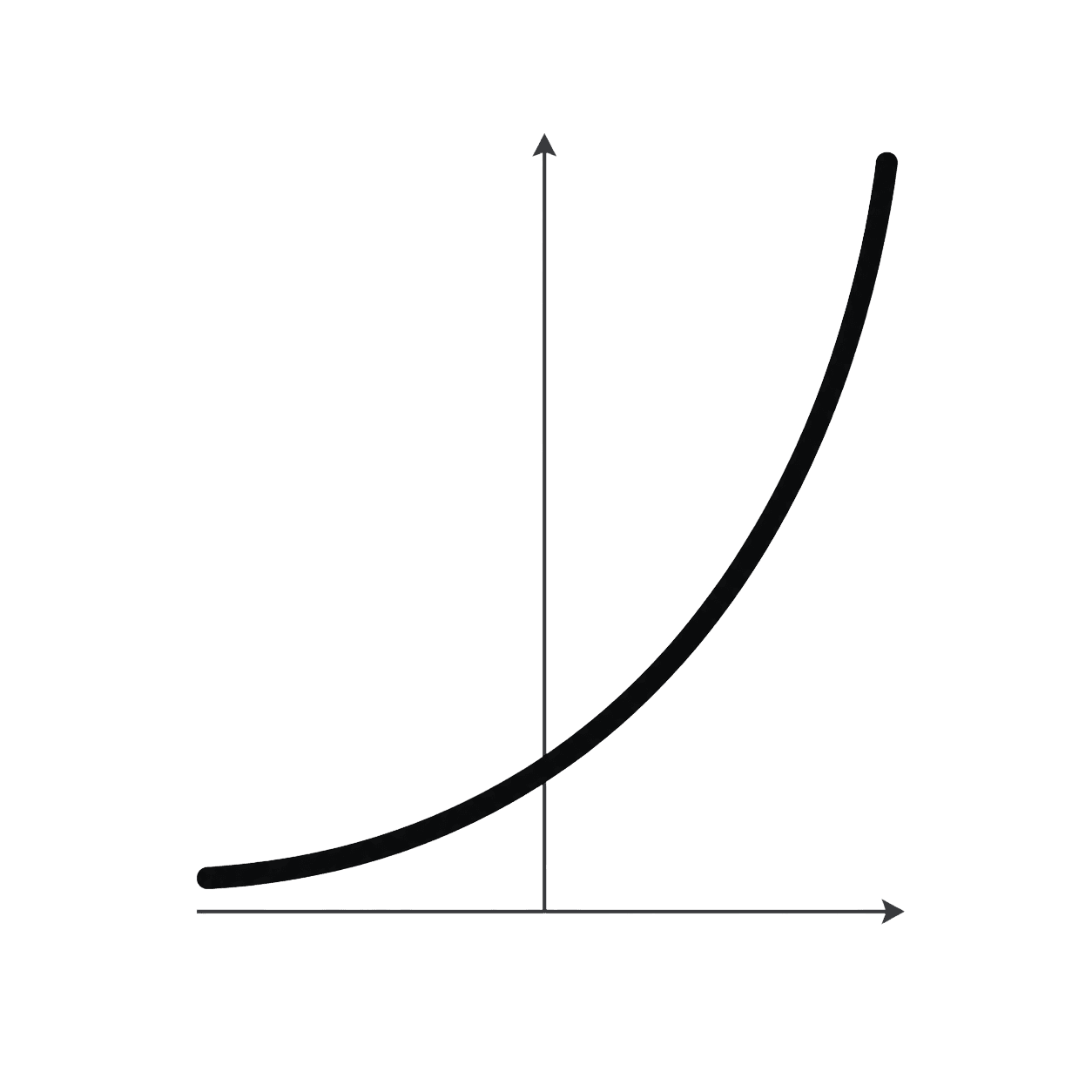
y=bx
the exponential curve
a programmatically enforced curve that only goes up.
an on-chain program claims the fee stream from every trade and splits it in two: half bids for the token on the open market and burns what it fills, half backs a reserve any holder can redeem against.
the floor against the order flow that produces it, hourly. the upper curve is the reserve leg of the fee stream divided by circulating supply, accumulated across every bar of real traded volume. below the baseline, flow is split by direction — buy-dominant bars above, sell-dominant below. figures the program alone can report, once it is live, read as loading rather than as a number.
abstract
$y=bˣ is a Token-2022 mint whose creator-fee stream is claimed by a program rather than by a wallet. Each claim is split in a ratio fixed at deployment: 50.00% is spent bidding for the token on the open market and burning what it fills, and 50.00% is retained in a reserve account that collateralizes redemption. The allocation is not discretionary and there is no path by which either half reaches an individual.
What this produces is a floor: the reserve balance divided by circulating supply, denominated in SOL, computable from two account balances and nothing else. It does not depend on the price of the token, on continued inflows, or on anyone's intent. It is an accounting identity over state that already exists on chain.
fee claim and allocation
Trading against the curve accrues creator revenue in SOL. The program claims it and routes it, in the same transaction, into two accounts. Neither leg is a transfer to a person, and the split is not a parameter anyone adjusts after the fact.
  bid_leg     = c · 0.50
  reserve_leg = c · 0.50

  R  ← R + reserve_leg
  B  ← B + bid_leg
Tokens minted against the curve are distributed across holders in proportion to balance. It is worth being precise about what that does: since every balance scales by the same factor, no holder's share of supply changes, and therefore no holder's claim on the reserve changes. Issuance is a distribution mechanism. The backing comes from the reserve leg, and the per-token improvement comes from retirement.
the floor
A holder of h tokens against a supply of S owns h/S of the reserve. Redemption pays that claim in SOL and retires the tokens presented.
floor = R / S

claim(h) = (h / S) · R
redemption is not dilutive
The standard objection to a redeemable claim is that early exits are paid out of the people who stay. Here they are not. Burning k tokens pays k·R/S and removes k from supply; numerator and denominator contract in the same proportion, so the floor is invariant under redemption.
redeem k:

  R' = R − kR/S
  S' = S − k

  R'/S' = (R − kR/S) / (S − k)
        = R(S − k)/S / (S − k)
= R/SAn exit fee moves it from invariant to strictly increasing. With f = 3.00% withheld, the redeemer receives (1−f)·k·R/S and the remainder stays in a reserve now divided by a smaller supply.
redeem k, withhold f:

  R' = R − (1−f)·kR/S
  S' = S − k

  R'/S' = (R/S) · (1 + f·k/(S − k))

  1 + f·k/(S − k) > 1     for 0 < f ≤ 1, 0 < k < S
when the bid may run
The bid leg spends reserve-adjacent capital into the market, which means it can destroy value as easily as create it. Spending ΔR at price P retires ΔR/P tokens, and the sign of the effect on the floor is determined entirely by where P sits relative to the floor itself.
spend ΔR at price P, burn ΔR/P tokens:

  floor' = (R − ΔR) / (S − ΔR/P)

  floor' > floor   ⟺   P < R/S

with u = ΔR/R and m = floor/P:

  floor'/floor = (1 − u) / (1 − u·m)
Enforced as a precondition rather than left to judgement, this makes the allocation a standing bid underneath the market: while price trades below the SOL backing each token, the program is a buyer and every fill raises the floor for everyone still holding. Above the floor it does nothing, and the allocation simply accumulates.